⚠️ État de l’art du NLP ⚠️
In the world of Research & Development, innovation is the engine of growth. However, a paradox is currently holding back even the most brilliant teams: in order to innovate, you need to know what already exists, but the volume of existing information has become humanly unmanageable.
With approximately 100,000 scientific papers published each year in each specific field (and many more in oncology and AI), manually compiling an exhaustive overview of the current state of the art is nothing short of utopian. As Sylvain Massip pointed out during the recent webinar on monitoring technologies: “To read 100,000 papers in a year, you would need a team of 45 full-time staff.”
Faced with this reality, traditional methodologies (Excel + PubMed + Google Scholar) are becoming obsolete. A new era is dawning: that of human-AI collaboration, where artificial intelligence does not replace researchers, but acts as a cognitive exoskeleton.
Summary:
Getting started with a new state of the art is often laborious. You have to define keywords, try risky Boolean combinations, and hope you don’t miss a crucial synonym. This “framing” stage usually takes 1 to 2 hours and relies entirely on the researcher’s intuition.
L’IA permet désormais d’inverser le processus. Au lieu de chercher des mots-clés, le chercheur pose une question en langage naturel (ex: “Quels sont les verrous technologiques actuels dans les thérapies géniques ?”).
L’IA, via des agents de recherche, va :
The benefit: You no longer start with a blank page. AI suggests angles of attack that the researcher may not have considered, transforming a passive research task into an active validation task.
This is where the technological divide is most visible. Database fragmentation is a watcher’s nightmare.
The challenge of “multi-bases”
A researcher must juggle between:
This step requires manually deduplicating the results in an Excel file, a time-consuming task (5 to 10 hours) with no added value.
Next-generation platforms such as Opscidia centralise these flows (articles, patents, theses, European projects) in a single repository containing over 200 million documents.
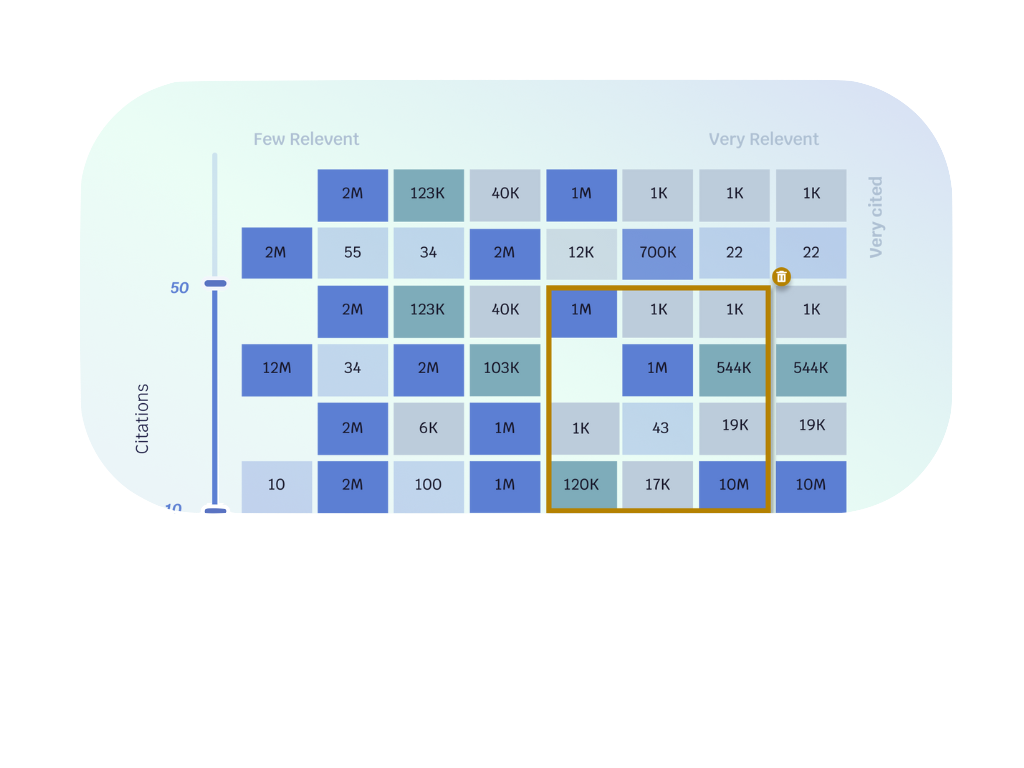
But the real revolution lies in sorting. Instead of a linear list of 15,000 results, AI enables dynamic visualisation along two critical axes:
Conceptual Diagram: Filtering by Graph
This visualisation allows researchers to visually define their own quality threshold, instantly isolating the “gems” from the incidental documents.
Once 50 documents have been selected, they must be read. This is the absolute bottleneck.
Example of interaction:
Key point to note: Unlike generic tools such as ChatGPT or Perplexity, which can hallucinate, AI systems specialising in science display sources sentence by sentence (Source: Article X, Paragraph Y). Users can verify the information with a single click.
Writing is often the most dreaded stage (writer’s block). The modern approach is based on the concept: “AI proposes, the expert disposes”.
The ideal workflow breaks down as follows:
Stage | Manual Method (Est.) | AI-assisted method (Est.) |
Framing | 2h | 0.5h |
Search & Sort | 5h | 1h |
Reading & Analysis | 1 day + | 2h |
Writing | 1 day + | 2h |
TOTAL | ~3 to 4 days | ~1 day |
Result: An observed time saving of 50 to 60% across the entire process, allowing researchers to focus on critical analysis rather than data collection.
One recurring question deserves to be addressed: Why pay for a specialised platform when ChatGPT or Perplexity exist?
The answer can be summarised in three key points, which were discussed during the webinar:
Hallucination Management: In science, false references are unacceptable. Specialised RAG (Retrieval-Augmented Generation) pipelines constrain AI to respond only on the basis of the documents provided, drastically reducing the error rate.
Artificial intelligence will not replace scientists. However, scientists who use AI will replace those who do not.
The adoption of these platforms is transforming scientific monitoring, transforming it from a “necessary chore” into a fast and accurate strategic lever. By freeing up 60% of their time, researchers can finally devote themselves to what no machine can do: interpret, imagine and innovate.